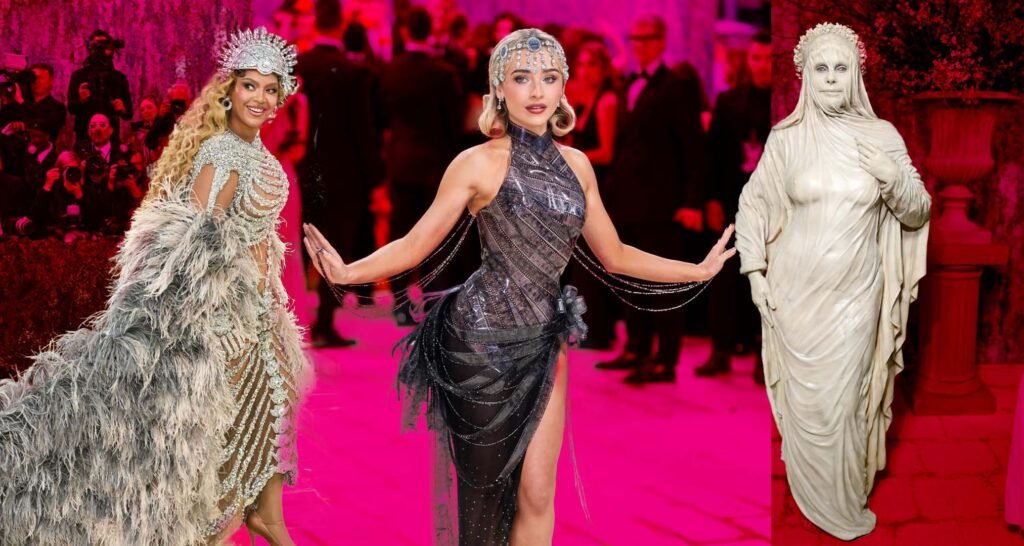
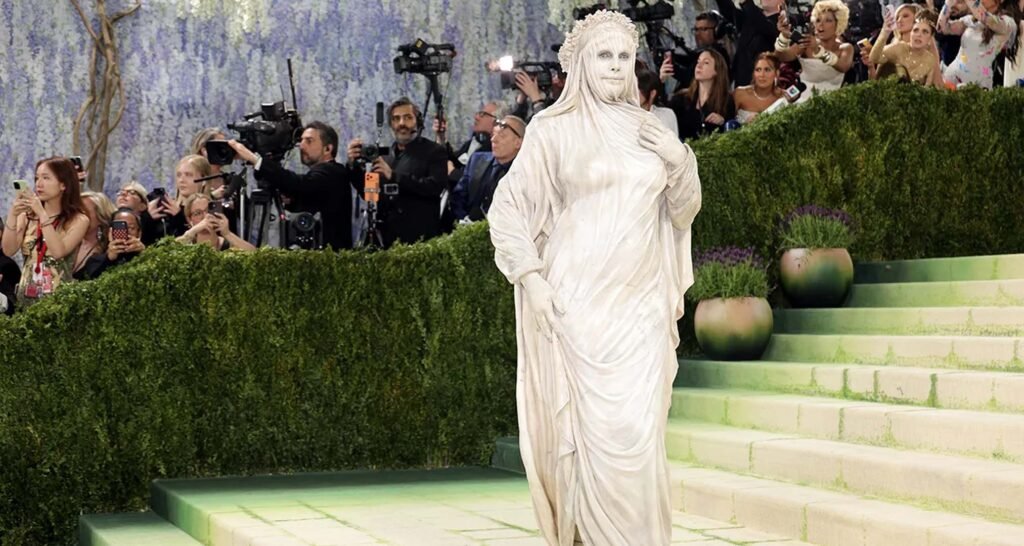
The carpet fell silent at the Metropolitan Museum of Art on May 4, 2026. Then Heidi Klum stepped into the floodlights. She was marble. Not wearing marble, not channeling marble. She was a Grecian statue from antiquity walking fashion’s most photographed steps. The crowd froze. Three thousand camera phones went up simultaneously. The internet cracked open within four minutes of her arrival.
That single image made the night’s entire argument before a second celebrity touched the top step. The met gala 2026 looks did not simply deliver beautiful outfits. They executed a verdict. Four years of beige, logo-free, old-money minimalism died on those steps. Sculptural fashion, art-history-loaded drama, and culturally specific couture took over completely. The 2026 Met Gala theme was “Costume Art.” The dress code instructed every guest to arrive as art itself. Co-chairs Beyoncé, Nicole Kidman, Venus Williams, and Anna Wintour ran the night at the Metropolitan Museum of Art in New York.
Five specific trends emerged from that red carpet. Each one lands directly in South Asian wardrobes, wedding season shopping lists, and the way a generation is about to dress. One of those trends involves a story no Western outlet has told properly. Quill Quest Magazine is telling it first.
Gigi Hadid in DHL Dress: How This Tape Look Became 2024’s Biggest Fashion Buzz
What Was the Met Gala 2026 Theme and Why Does It Change Everything?
The 2026 Met Gala theme was “Costume Art.” The dress code gave guests one instruction: come as art itself. Not art-inspired. Not art-adjacent. Art.
The theme connected to the Costume Institute’s spring exhibition of the same name. Vogue, the official organiser and media partner, framed the exhibition as examining the dressed body across time and culture. The exhibition placed garments alongside fine art from the museum’s vast collection. Its central argument: fashion and fine art were never separate disciplines.
That brief transformed the entire character of the met gala outfits 2026. Every look that succeeded had a real art-historical anchor. Heidi Klum referenced antiquity’s Grecian sculpture. Sabrina Carpenter wore film reels from a 1954 Audrey Hepburn classic. CNN’s full red carpet coverage confirmed that Lena Dunham’s Valentino gown transformed the blood spray from Artemisia Gentileschi’s “Judith Beheading Holofernes” into a vibrant red dress. Hunter Schafer channeled Gustav Klimt in Prada. Emma Chamberlain wore a hand-painted Mugler gown by Miguel Castro Freitas as a nod to Impressionism. Angela Bassett wore hot pink Prabal Gurung as a deliberate tribute to the Harlem Renaissance.
The met gala 2026 looks were not fashion statements. They were research presentations dressed in couture.
The 2026 Met Gala took place on May 4, 2026. The venue was the Metropolitan Museum of Art on Fifth Avenue in New York. Ticket prices reached $100,000 per seat. Wikipedia’s documented history of the event records the price at $75,000 in 2025. That figure matters. The most expensive fashion gathering in the world attracted hundreds of millions of viewers watching on phones. Understanding that gap is understanding the Met Gala entirely.
Zendaya 2026 Stacks Five Releases and the Whole World Is Paying Attention
The Met Gala 2026 Looks Decoded: Five Trends That Will Hit Your Wardrobe
Five fashion movements launched from the 2026 Met Gala red carpet. Each began with a celebrity. Each arrives in a high street near you within two seasons. Each carries a direct South Asian wardrobe translation. Here they are, in order of cultural urgency.
Trend 1: Heidi Klum and Kylie Jenner Just Launched the Statue Dress Era
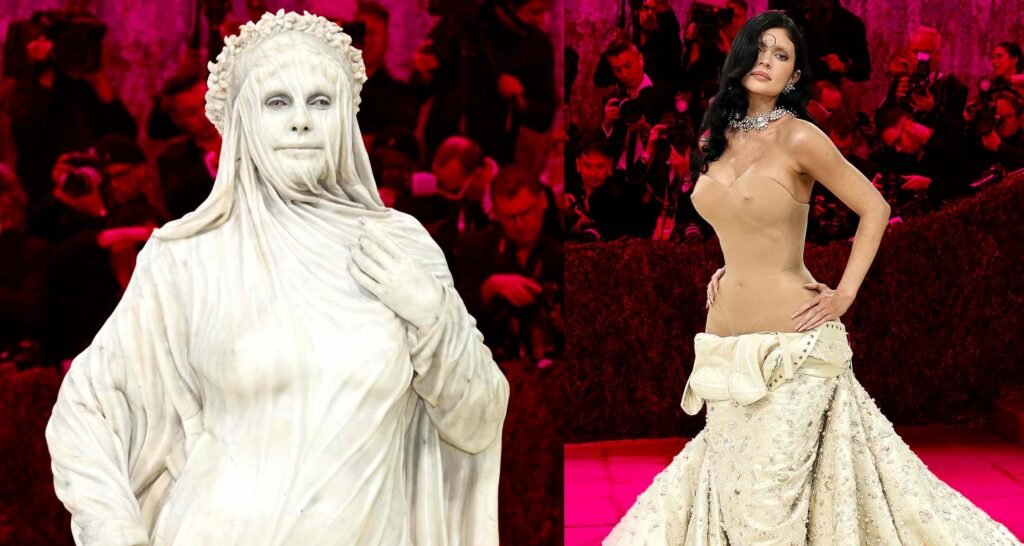
Heidi Klum walked the carpet as a living Grecian statue. This was not approximation. Her silhouette was rigid. Her texture was carved stone. The look was fully, convincingly architectural from every angle. NBC News covered it with the simplest possible verdict: “Heidi Klum is statuesque.” That understatement was the politest possible response to an outfit that genuinely stopped the night cold.
Kylie Jenner followed in Schiaparelli. A light-beige dramatic gown featured a long beaded train and cape. Schiaparelli’s signature surrealist detail appeared as a trompe-l’oeil illusion of a bare chest. Jenner completed the look with bleached brows and a single sculpted curl. The effect: a living sculpture read through the surrealist lens.
Kim Kardashian appeared in custom Allen Jones and Whitake Malem. CNN’s full coverage described the look as one of her most understated Met Gala appearances yet. This was her 13th time attending the event. Cardi B closed the carpet in an exaggerated sculptural Marc Jacobs silhouette. Hailey Bieber wore cobalt blue Saint Laurent with clear structural force.
Sculptural fashion is the direct successor to quiet luxury. Where quiet luxury said “less is more,” sculptural fashion says the shape is the entire statement. Fashion now treats the body as a canvas. Structured shoulders, stiffened fabrics, and garments holding their shape independently of the body beneath them define this movement.
After years of beige, logo-free minimalism dominating social media, consumers want drama. Business of Fashion trend forecasts for late 2026 consistently point toward dramatic silhouettes. Every South Asian pret label should release structured occasion wear in the fourth quarter of 2026.
For Pakistani and Indian readers, the translation is already written in their own fashion history. The architectural quality of a well-constructed sharara. The volume of a properly stiffened lehenga skirt. The geometry of a tailored sherwani. South Asian couture has always known this language. Structure is glamour. That truth is not new. It is simply now confirmed at the world’s most expensive fashion event. For wedding season shopping: prioritize lehengas with structured bodices and bridal blouses with defined architectural silhouettes. One sculptural element per look. Let everything else stay quiet.
Trend 2: Sabrina Carpenter Met Gala 2026 Proved Nostalgia Is Fashion’s New Language
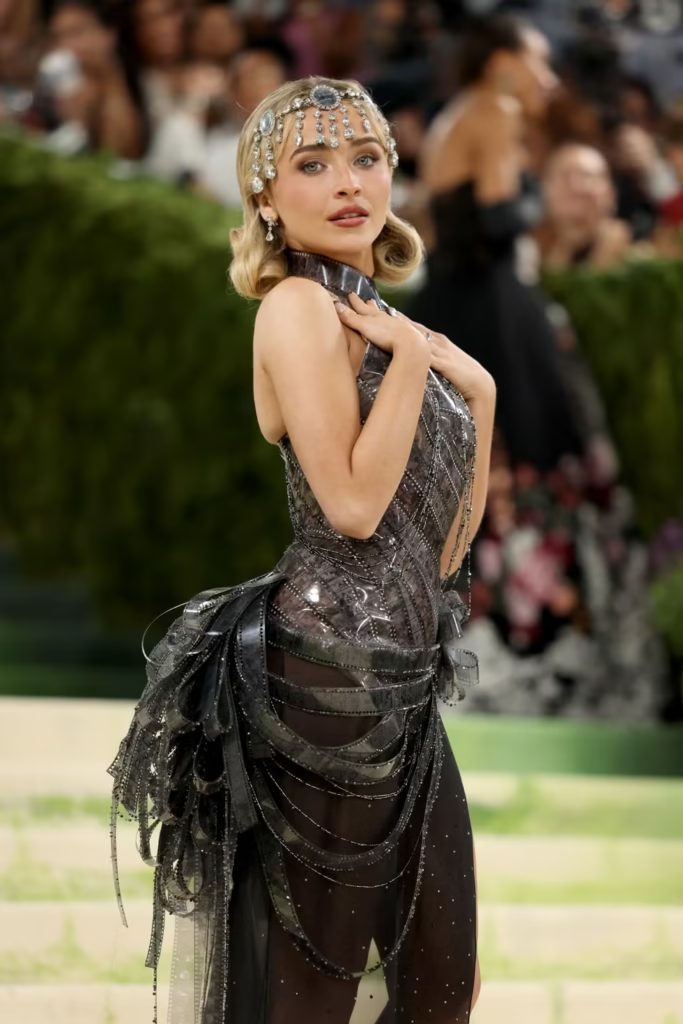
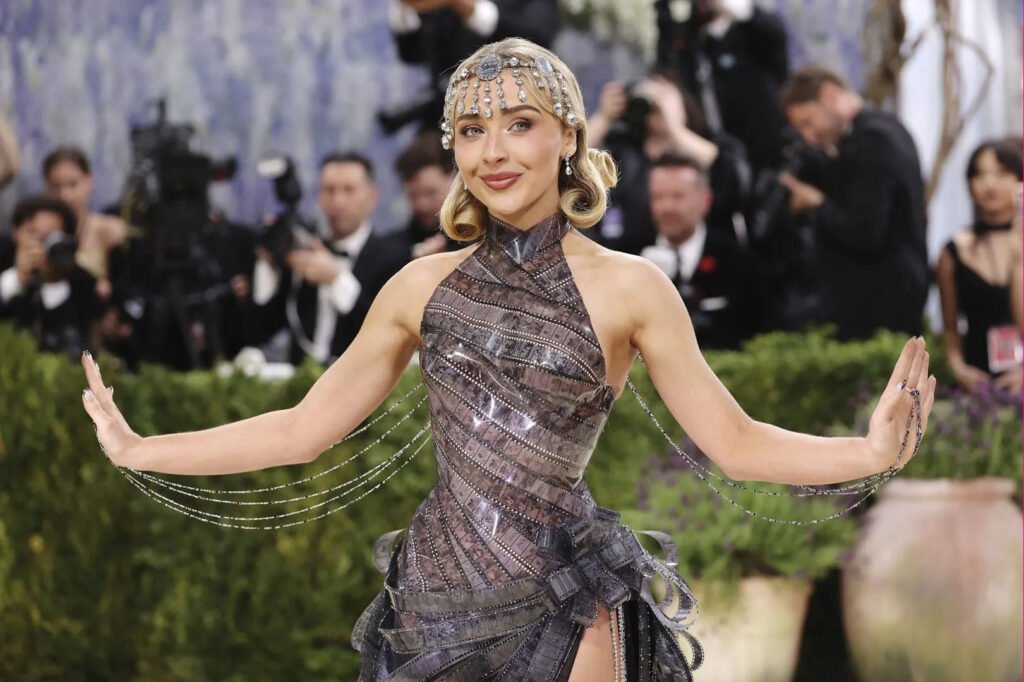
Sabrina Carpenter arrived in a Jonathan Anderson-designed Christian Dior gown. The Irish Times confirmed the gown was constructed from actual film reels of the 1954 Audrey Hepburn film “Sabrina.” A corseted bodice shaped her frame. The skirt unraveled into ribbon-like layers of film strip. A jeweled headpiece connected the back of the dress to her fingers like open wings.
Carpenter told reporters on the carpet: “It’s all made of film, which is my dream.”
Blake Lively arrived in archival Versace with a 13-foot train. The Irish Times reported the gown drew from Rococo paintings in its multi-pastel construction. Cara Delevingne wore flowing jet-black Ralph Lauren with mesh sleeves and a beaded back panel. The pattern across all three looks: rich fabrication, cinematic scale, and old-world embellishment worn with modern confidence.
The sabrina carpenter met gala 2026 look represents nostalgia dressing in its most fully evolved form. This is not wearing vintage. This is capturing a feeling. Timeless. Cinematic. Hand-crafted. Unhurried. Film reels, dramatic trains, jeweled headpieces, and silhouettes from golden-age cinema form this movement’s visual vocabulary. Gen Z obsesses over film photography and analog aesthetics. This trend feeds directly into that hunger for anything predating the algorithm.
Every major fall 2026 collection carries nostalgia references. The clean girl aesthetic of 2022 to 2024 is culturally exhausted. Consumers want storytelling in their clothes again.
For South Asian readers, nostalgia dressing reads like a native language. Pakistani and Indian formal fashion has always celebrated embellishment, draping, and rich fabrication. Heavily embroidered dupattas worn as statement capes, trailing silk and organza skirts, jeweled headpieces as alternatives to traditional matha patti, and sarees in metallic or sequined fabrics all translate this trend directly into occasion wear. The nostalgia dressing movement gives South Asian fashion an international frame of reference that validates what our designers have always done.
Trend 3: Are Power Metallics the New Year-Round Formal? Rihanna and Serena Williams Say Yes
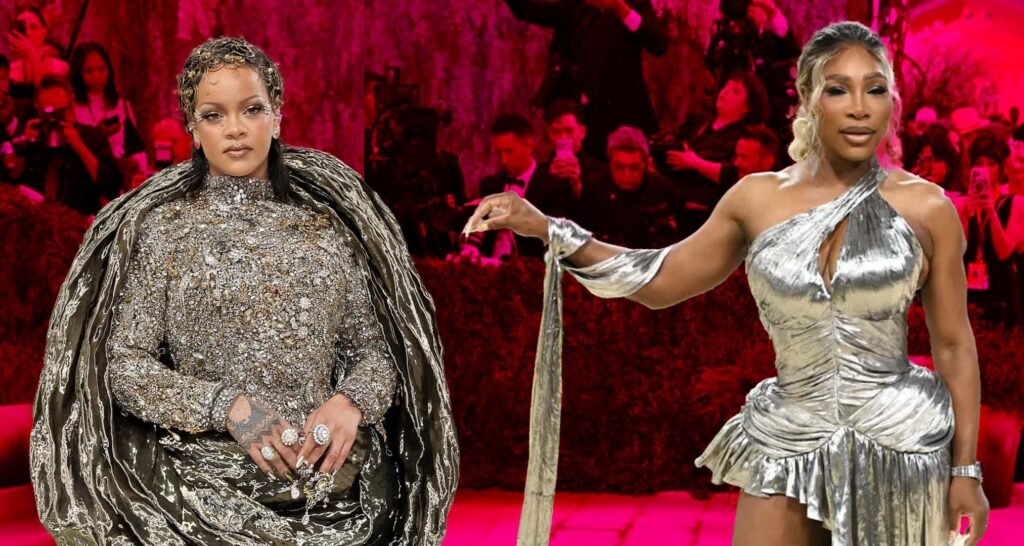
Rihanna arrived last. That is tradition. She came in a draped metallic look from Maison Margiela by creative director Glenn Martens. A$AP Rocky walked beside her in pink Chanel. CBS News New York’s live coverage captured the moment: “Rihanna wears a glittering outfit tonight.” The restraint of that description matched the look’s own deliberate authority.
Serena Williams wore a draped silver mini dress by Marc Jacobs. CNN reported Marc Jacobs drew inspiration from statues for the design. Gold spikes traced up the leg along the slit. The look merged athletic power with fashion authority. It was armor. Expensive, glamorous, intentional armor built from precious metal and structural draping.
Irina Shayk wore an Alexander Wang creation containing no traditional fabric at all. Watches formed armband cuffs. Necklaces became a choker. According to CBS News New York’s live red carpet updates, the outfit replaced fabric entirely with metallic jewelry deployed as sculptural art objects.
Power metallics differ from party sequins in one critical quality: intent. Sequins celebrate. Power metallics command. This is “boardroom in gold” dressing. Silhouettes are sleek, draped, or structured. The fabric makes the entire argumentative case. The rihanna met gala 2026 look and the Serena Williams Marc Jacobs gladiator silhouette are two expressions of one principle: metallic worn as authority, not decoration.
Silver and gold fabrics already appear across every fast fashion chain’s formal range. The 2026 Met Gala shifted the cultural context. It reframed metallic as a year-round power choice rather than a New Year’s Eve option. Metallic separates like a silver blazer or a gold midi skirt will become formal staples through 2027.
For South Asian readers, metallic sits deep in our fashion DNA. Zardozi embroidery, gota kinari, metallic tissue fabric, silver thread work. The shift is in context, not color. Not metallic as decoration applied to a colored garment. Metallic as the garment’s entire argument. A pure silver tissue kurta with minimal embellishment. A gold straight-cut gown where the fabric tells the story completely. Our traditional metallic expertise now wears a contemporary silhouette.
Trend 4: SZA Met Gala 2026 and the Grown-Up Return of Dopamine Dressing
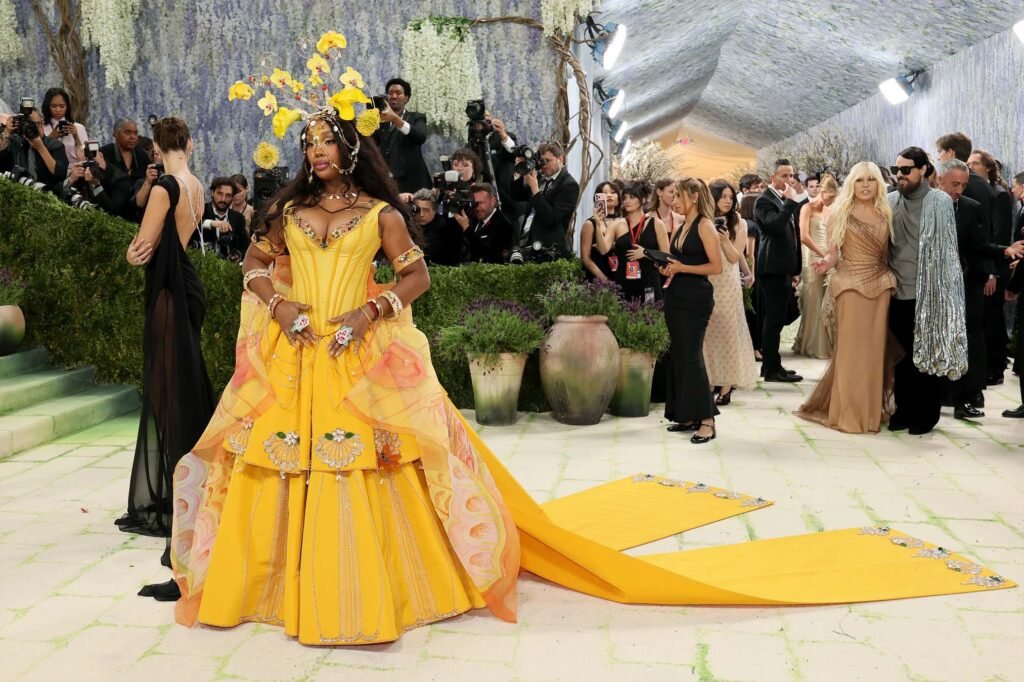
SZA arrived in sunshine yellow by Bode. The color made a statement. The label choice made a bolder one. Bode is an American brand built on considered, meaningful craftsmanship and deliberate material sourcing. CNN’s red carpet roundup confirmed that SZA’s Bode gown repurposed garments found on eBay. That detail transforms the reading completely. This was not just bold, unapologetic color. This was sustainable fashion wearing one of the night’s loudest arguments.
Angela Bassett wore hot pink Prabal Gurung with matching makeup. NBC News described the look as delivering the carpet “a much-needed pop of color.” Both women shared the same energy: one saturated hue worn with complete conviction and zero apology.
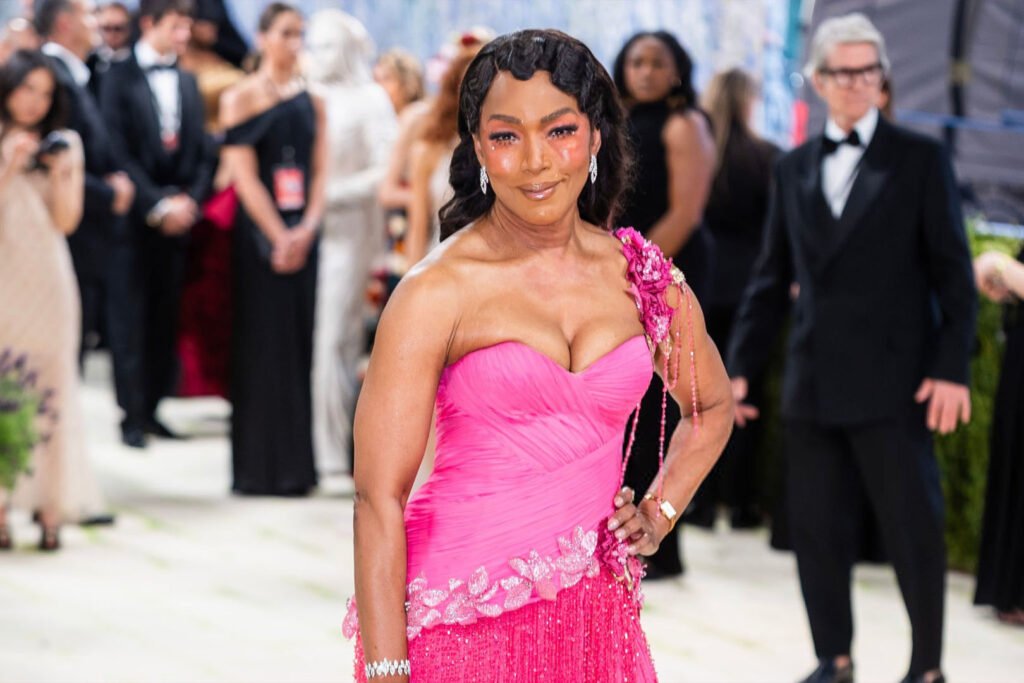
Dopamine dressing, the practice of wearing bright saturated color specifically for the psychological lift it creates, dominated 2021 and 2022 before quiet luxury buried it under beige. The sza met gala 2026 arrival formally signals its return. But this iteration has grown up. This is not rainbow maximalism. This is single-color power dressing. One saturated hue. Worn with craft, conviction, and conscious design.
Consumer research in fashion psychology consistently shows that fashion pivots toward bold, optimistic color after periods of cultural strain. H&M, Zara, and ASOS spring 2026 collections are already loaded with saturated primary and secondary colors. The trickle-down from the met gala best dressed 2026 arrivals is already in motion at commercial scale.
For Pakistani and Indian readers, South Asian formal fashion has always understood this instinct at its deepest level. Our entire formal vocabulary runs on bold, saturated color. The upgrade the 2026 Met Gala adds is intentionality. Wear your sunshine yellow as a standalone statement. A simply cut mustard kurta with minimal embellishment. A single-color maxi in fuchsia with no dupatta. Let the color be the entire outfit. Less layering. More color confidence. Tonal dressing with texture variation is the direction to move in.
Trend 5: Manish Malhotra Brought Amrita Sher-Gil to the World’s Biggest Fashion Stage
This section is the one Western fashion media has not written. This is the 2026 Met Gala story that belongs to this publication’s readers first.
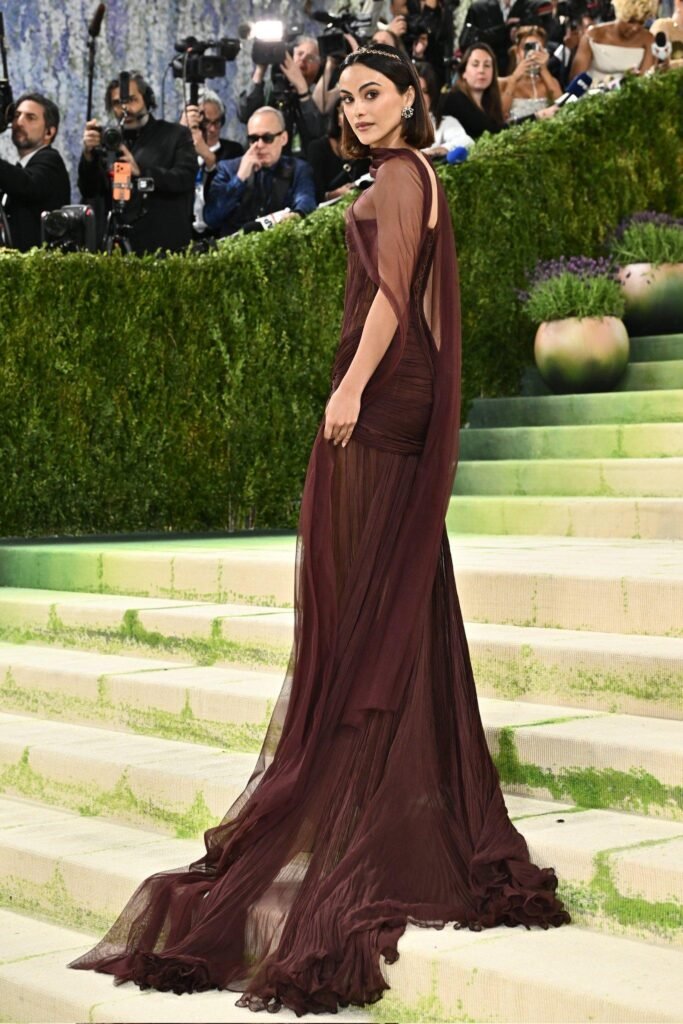
Camila Mendes, known globally for Riverdale and currently preparing for Masters of the Universe, walked the 2026 Met Gala red carpet in a custom gown by Indian designer Manish Malhotra. The gown was deep mahogany. A corseted base structured the bodice. Hand-ruched French chiffon gathered at the hip in a sculptural knot before cascading into a fluid trail. Malhotra’s official Instagram statement described the surface as evoking “the texture of dry brushstrokes, rendered in a deep mahogany hue drawn from the artist’s palette of Indian reds, browns, and ochres, lending depth and movement to the silhouette.” High jewellery in tourmalines, uncut diamonds, and 18-karat gold from Manish Malhotra High Jewellery completed the look.
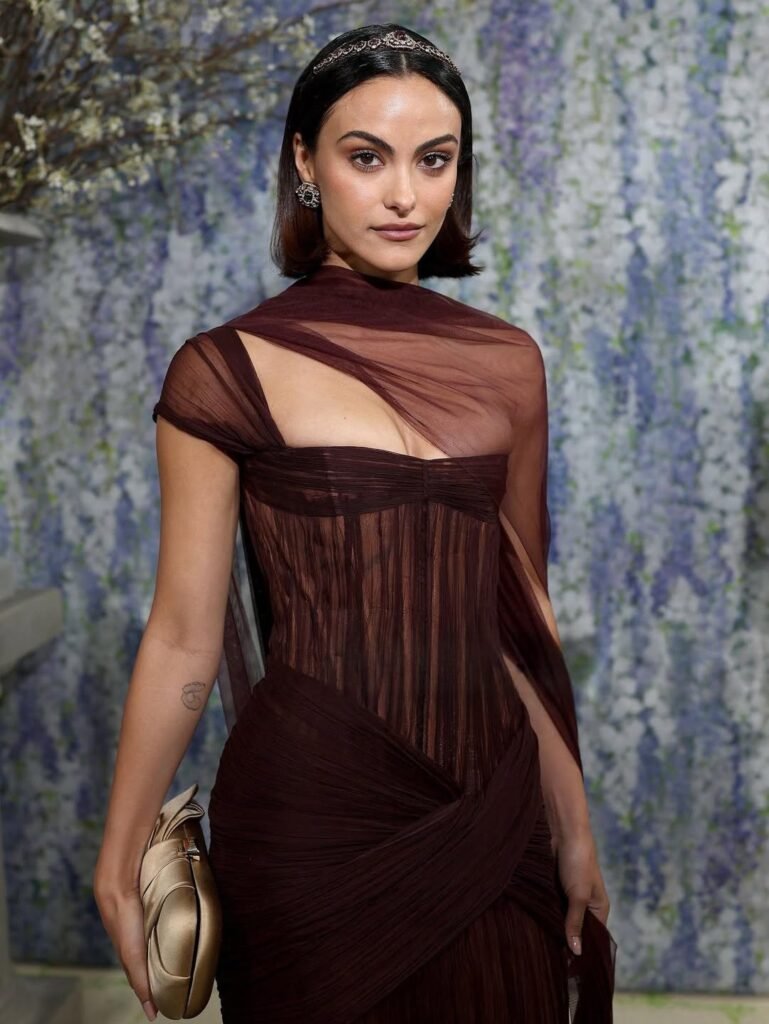
The inspiration was Amrita Sher-Gil.
Amrita Sher-Gil was a Hungarian-Indian painter who pioneered modern Indian art. That is the clean, single-sentence definition of who she was. The fuller story demands its own space.
Sher-Gil was born in Budapest on January 30, 1913. She died on December 5, 1941. Scholars call her “one of the greatest avant-garde women artists of the early 20th century” and a pioneer in modern Indian art. She was 28 years old at her death. According to Britannica, she produced approximately 150 works between 1934 and 1941, blending traditional Indian methods with Modernist European techniques. Her works are recognized as national art treasures in India, and the Indian government declared her a National Treasure artist in 1976. Sotheby’s describes her painted subjects as revealing “loneliness or silent resolve,” treating female subjects in a way that was singularly unique for the era.
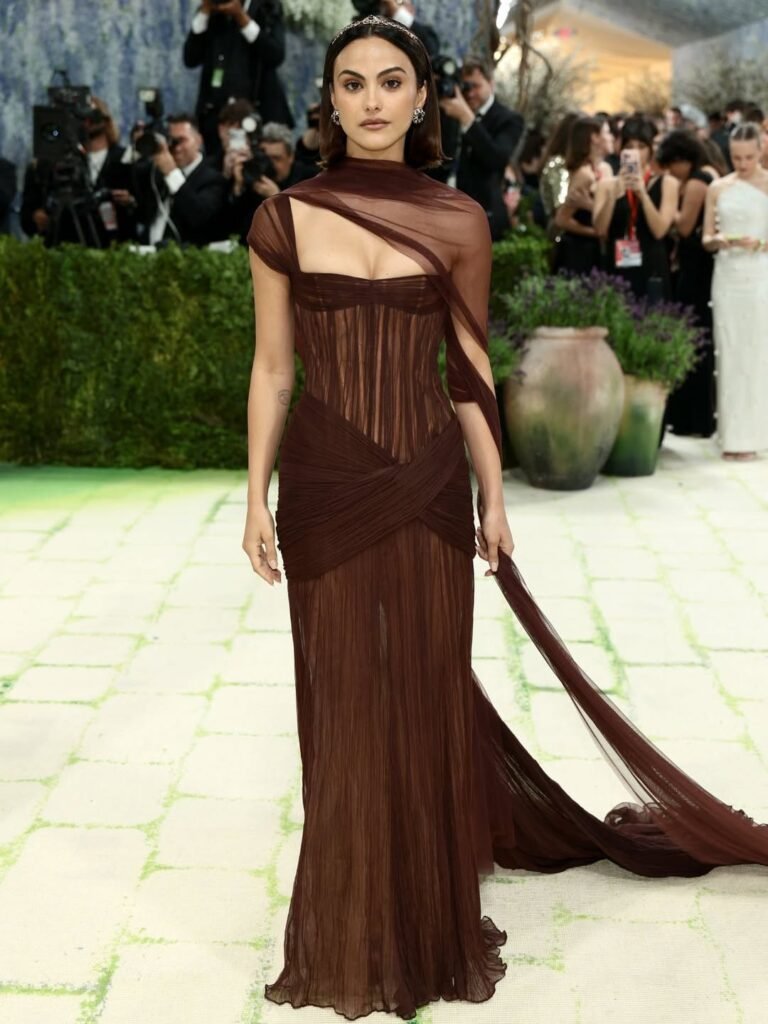
She trained at the École des Beaux-Arts in Paris. She returned to India compelled by, in her own words, “an intense longing to return to India, feeling in some strange way that there lay my destiny as a painter.” Her palette became saturated with intense reds, ochres, browns, yellows, and greens upon her return, and her female forms demanded attention. They were both sensuous and vulnerable. They were subjects and objects at the same time.
These are the exact tones Manish Malhotra pulled into mahogany couture in 2026. The conversation between painter and designer, across 85 years and the distance between Lahore and New York, is what makes this the night’s most intellectually complete look.
She wrote from Shimla. She died in Lahore. Her connection to this region is not a footnote. It is the entire point.
Karan Johar also attended the 2026 Met Gala in Manish Malhotra. According to ANI, Johar wore a black bandhgala layered with a 960-hour cape crafted by 50 artisans, paying tribute to Mumbai’s artisanal heritage. Johar told reporters on the carpet: “I didn’t want to arrive here trying to explain India. I wanted to arrive feeling like myself and that automatically brings everything I come from with it.”
That quote requires no additional commentary.
The 2026 Met Gala theme was “Fashion Is Art.” Within that theme, one of the most intellectually complete looks on the entire carpet cited an Indian painter born in Budapest, trained in Paris, and buried in Lahore. Amrita Sher-Gil does not appear in Rolling Stone’s Met Gala coverage. She does not appear in the Washington Post’s best-dressed list. She is not part of Western fashion media’s vocabulary. But she belongs to this publication’s readers’ heritage in a way no Western outlet can claim.
When Manish Malhotra stood on those Metropolitan Museum steps alongside Olivier Rousteing, Jonathan Anderson, and Glenn Martens, he was not receiving inclusion in global fashion. He was confirming his belonging to it. For every South Asian reader who has watched their culture described as “ethnic” instead of haute couture, that distinction matters more than any best-dressed list ever written.
From Y2K Dreams to TikTok Feeds: The Nostalgia Trend 2025 Culture Explained
Why Do We All Stay Up Past Midnight Watching a Party We’ll Never Attend?
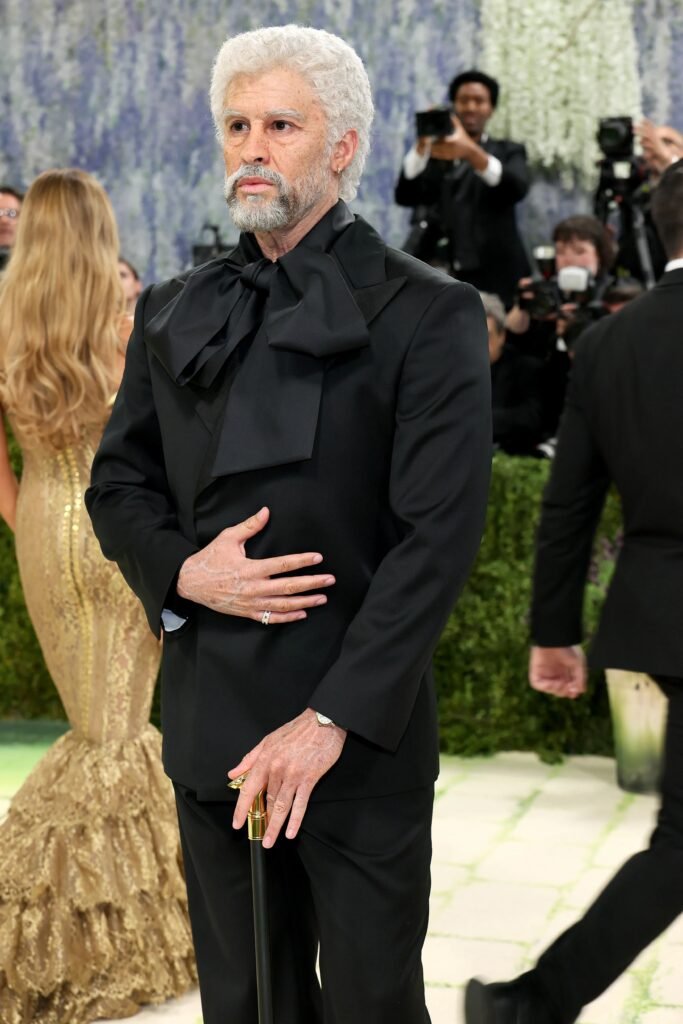
The 2026 Met Gala ticket cost $100,000 per person. Hundreds of millions of people watched it from their phones. That gap between the event’s price and its global viewership is not a paradox. It is the entire design.
The Met Gala functions as aspirational content in its purest form. Aspirational content differs from inspirational content in one precise way. Inspirational content shows you something achievable. Aspirational content shows you something deliberately, beautifully out of reach. Psychologists document the emotional response this creates: fascination, longing, motivation, and sometimes inadequacy. The Met Gala produces all four simultaneously, on a single Monday night in May.
Emma Chamberlain hosted Vogue’s official livestream in a hand-painted custom Mugler gown by Miguel Castro Freitas, inspired by Impressionism. She stood inside the event. She also represented everyone watching from outside it. That dual positioning is exactly why she works as the cultural bridge. She attended the room. We attended through her eyes, her reactions, and her camera angle.
Following the met gala 2026 looks is also, for hundreds of millions of young South Asians, participation in a global cultural conversation. Young people in Pakistan and India grew up consuming global culture through satellite channels, YouTube, and Instagram. The Met Gala is one of the few events in the world where fashion, art, music, film, and sport converge on a single night. When someone writes “she gave Met Gala energy” in a comment section, you know precisely what they mean. That shared cultural language did not exist twenty years ago. Its existence now is not trivial. It is connection across geographic and economic distance.
Instagram and X turned a closed, private event into a participatory public experience. Real-time arguments about best dressed and worst dressed became a parallel event with its own energy and audience. The met gala red carpet 2026 was, in a real and documentable sense, the most participatory carpet in the event’s history. We voted on looks, argued about theme adherence, memed Heidi Klum’s statue, and reposted Beyoncé’s skeleton before the night was over.
However, aspirational watching carries real risk. The comparison cycle that makes social media psychologically damaging applies equally to Met Gala watching. The distance between a $100,000 ticket and a bedroom in Lahore is real. The healthy approach is deliberate. Watch for fuel, not measurement. Let Beyoncé’s return push you toward your own bolder choices. Let Manish Malhotra on those steps confirm what you already knew: South Asian fashion belongs on every stage the world has built. Use the aspiration. Do not let it define your worth.
Unlock the Dark Side with Vampy Trends for 2026 That Bite Back
The Night Fashion Remembered It Was More Than Clothes
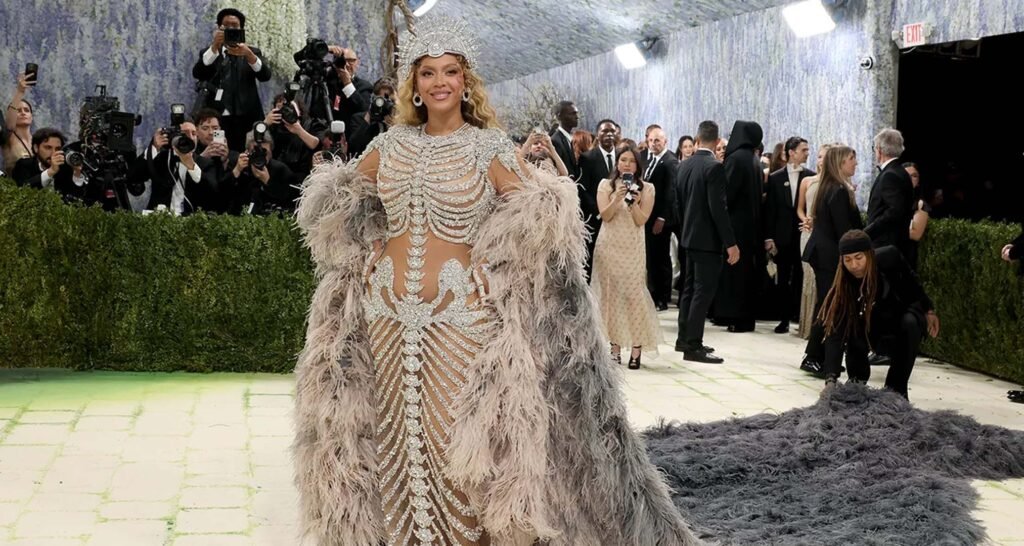
Beyoncé had not attended the Met Gala for ten years. Her last appearance was in 2016 in Givenchy Haute Couture, for the “Manus x Machina” theme, according to The Hollywood Reporter. She returned in 2026 as co-chair in a custom diamond-encrusted skeletal gown by Olivier Rousteing, the former creative director of Balmain. The gown was sheer. The skeletal detailing ran across the front, down the back, and through the full train. A dramatic fur coat completed the look.
She told La La Anthony on the red carpet: “[He’s] someone that’s been so loyal to me, and I’ve done so many incredible, iconic looks with him, so it’s really about representing him.”
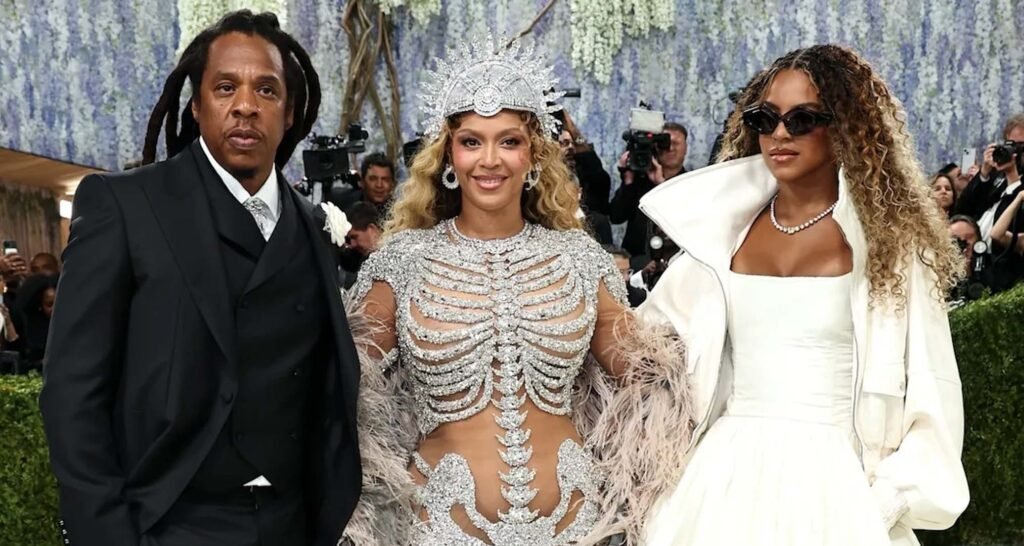
Jay-Z stood beside her in Louis Vuitton. Blue Ivy Carter stood at her side in all-white Balenciaga, blonde mermaid braids, and black shades. She was 14 years old. According to Hello Beautiful’s red carpet coverage, Beyoncé watched her daughter command the cameras and said: “She is ready.”
The symbolism of a diamond skeleton is not accidental. Beyoncé does nothing accidentally. Strip away the gown, the diamonds, the decade of absence, and underneath is still a human being. That is what the skeleton says. The feathered fur coat says: but the transformation is undeniable and entirely earned. A Black woman who has defined global popular culture for two decades returned to fashion’s most elite stage with her daughter beside her. That is the image of 2026.
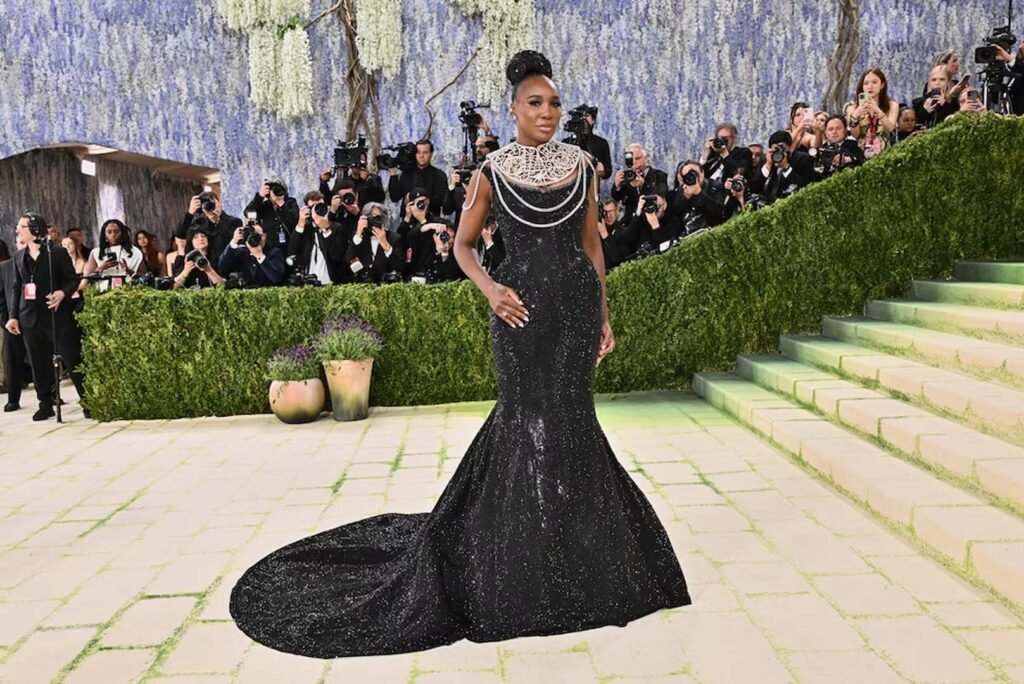
Venus Williams served as co-chair. Her sister Serena walked the carpet in metallic Marc Jacobs. Two women from Compton, California spent decades being told that tennis courts, fashion runways, and elite cultural spaces were not built for people who looked like them. In 2026, they ran one of those spaces at the highest possible level. This is not a diversity milestone talking point. It is the natural conclusion of a long, slow, earned arc completing itself.
Bad Bunny wore custom Zara. He aged himself five decades through prosthetics for his debut appearance. CNN reported that the Spanish retailer framed the look as “a genuine, considered reflection on what aging looks like and what it means.” At a $100,000-per-ticket event, wearing Zara declares something specific. The best ideas belong to everyone in the room. Regardless of what they paid to be there.
For readers in Lahore, Karachi, Delhi, and Mumbai, the 2026 Met Gala theme “Fashion Is Art” is not a revelation. It is a confirmation arriving decades late. You have known it every time light caught the thread work on a bridal lehenga. Every time a karigar in Lucknow spent six months completing a chikankari dupatta. Every time Western fashion called South Asian clothing “ethnic” instead of haute couture, that was the lie. The 2026 Met Gala confirmed what this region has practiced for centuries. Not as a gift. As a long-overdue acknowledgement.
The question is not whether South Asian fashion is art. The question is how much longer the world will pretend the recognition is its own discovery.
Final thoughts
The 2026 Met Gala produced five trends, two cultural milestones, and one story the Western press missed completely. Sculptural silhouettes, nostalgia dressing, power metallics, dopamine dressing, and South Asian couture all confirmed their place on the world’s most photographed steps. These are not abstract fashion movements for fashion people. They are directions. Each one points somewhere specific and immediate.
The met gala 2026 looks told a story about where fashion moves next. But they also reflected something deeper. The world’s most expensive fashion event is producing its most culturally diverse and intellectually serious red carpets in decades. That is not coincidence. That is consequence.
Manish Malhotra placed Amrita Sher-Gil’s palette on a red carpet watched by hundreds of millions of people. Nobody asked for permission. Nobody needed to. South Asian fashion has never required permission to be art. It has required a stage large enough to be seen. The 2026 Met Gala did not give South Asian fashion that stage. It simply confirmed the stage was always ours.