
MARWA TAHIR / Pakistan
The Pakistan Economic Survey 2025-26 records three numbers that define the crisis. Pakistan produces over 500,000 graduates every year. Its formal job market generates fewer than 200,000 positions annually. Youth unemployment stands at 11.6 percent. Graduate unemployment sits far higher. The system produces people the economy cannot absorb. Higher education in Pakistan runs on a promise it consistently fails to keep. Students sacrifice years. Families sacrifice money they cannot spare. The system accepts the investment. Then it returns a certificate into a market with no place for it.
This is not a personal failure. It is a structural one. The data confirms it. The students living it already know.
Transactional Marriage in Pakistan: The Daughters Who Pay
The System Filters Out Most People Before They Begin
Pakistan’s 2023 Population and Housing Census records a national literacy rate of 60.65 percent. Males stand at 68 percent. Females at 52.8 percent. The gap states something plainly before any university conversation begins.
Pakistan Education Statistics 2022-23 records the overall out-of-school rate at 38 percent. For females it reaches 42 percent. In Balochistan it is 69 percent. In Sindh, 47 percent. Urban literacy reaches 74.09 percent. Rural literacy sits at 51.56 percent.
Pakistan Education Statistics 2021-22 shows the primary Gross Enrolment Ratio fell from 97 percent in 2016-17 to 76 percent in 2021-22. Upper secondary GER stands at just 32 percent. The dropout pattern intensifies at every level.
A student from rural Balochistan and one from urban Lahore do not navigate the same system. The name is the same. The experience is not. The university conversation begins only for those who survive what comes before it.
Space Camp 2025 Ignites a New Era for Women in Pakistan’s Aerospace Scene
The Two-Year Degree That Takes Four Years to Finish

The affiliated college system refers to degree colleges that operate under a public university’s name but run on the university’s examination calendar, producing delays, backlogs, and supplementary exam cycles that routinely extend two-year programmes to four years or more.
The Undergraduate Education Policy Version 1.1, effective from Fall 2023, standardizes associate degrees at 60 to 72 credit hours over four to six semesters. Students who complete an associate degree may enter the fifth semester of an equivalent bachelor programme. On paper, the pathway is clear.
The reality runs differently. Affiliated college examinations fall under university control. Results delay. Papers reschedule. Supplementary exams push timelines by months, then by years. A student enrolls to finish in two years. The same student sits Part 2 exams in year three. Sometimes year four.
My friend and I took admission in 2022 together. She joined a university, while I enrolled in a college. She graduated in 2025, and I am still giving the exams for Part 2 of an Associate Degree. The author, on the affiliated college system, Karachi
I posted a question on Quora after years inside this system. The question: does completing a bachelor’s degree make sense after four years in an associate programme? Every foreign respondent misread the question entirely.
“Not only are you confused about academics, but you seem confused about what you are doing. Talk to your adviser about your situation”
Quora respondent, responding to a Pakistani student describing the affiliated college system
“HUH? Unless you are part time, an associate degree shouldn’t take 4 years.”
Quora respondent
The confusion belonged to the respondents, not the student. Pakistan’s affiliated college structure does not exist in most countries. A two-year degree that routinely takes four years is not a personal failure. Their inability to understand the question is evidence of how invisible the structural problem is outside Pakistan.
Three patterns repeat across the system. First: the credential trap. Hashir Mehtab, writing in The Express Tribune on May 14, 2026, reported that graduate unemployment significantly exceeds overall youth unemployment. High-CGPA graduates from public universities enter a market with no entry-level positions for them.
Second: the financial exit. Dr. Nadeem ul Haque, former Vice Chancellor of PIDE, has argued that Pakistani universities produce degree seekers rather than employable graduates. Many students leave before completion to support their families financially. Third: the delayed degree. The Undergraduate Education Policy Version 1.1 acknowledges that affiliated college students may take four to six semesters to complete a two-year associate programme. The policy names this as a structural feature. Students live it as a trap.
Feminism in Pakistan: The Bold Struggle Between Faith, Culture, and Equality
Enrollment Is Falling. Research Programs Are Emptying.
The University of Peshawar is one of the oldest institutions in Khyber-Pakhtunkhwa. The Express Tribune obtained official university documents and published its findings on May 14, 2026. PhD enrollment at Peshawar fell from 178 students in 2020 to just 66 in 2024-2025. A 63 percent decline in five years.
The HEC disbursed Rs 43.373 billion to higher education institutions in FY 2022-23. It funded 154 development projects, distributed 100,000 laptops under the PM Youth Laptop Scheme III, and connected over 400 institutions through the Pakistan Education and Research Network. In FY2025, Rs 61.1 billion went to 159 projects. Rs 12 billion funded another laptop scheme.
The spending and the outcomes move in opposite directions. PhD enrollment at one of Pakistan’s oldest universities fell 63 percent while billions moved through HEC accounts. Financial pressure, multi-year delays, and uncertain employment force students out. Mental exhaustion, not lack of commitment, drives the numbers down.
Does a Degree Actually Improve Your Chances in Pakistan?
Research by Henna Ahsan and Muhammad Jehangir Khan of the Pakistan Institute of Development Economics, answers this directly. Their paper draws on Labour Force Survey data from 2001 to 2021. Dawn published it on April 9, 2023. Overall unemployment in Pakistan runs at 6.3 percent. Graduate unemployment runs at 16.1 percent. The gap is nearly 10 percentage points wide. Female graduates carry the heaviest burden. Their research shows female graduate unemployment running 3.8 times higher than male graduate unemployment. Over one-third of women graduates held no employment in 2020-2021. Graduates aged 21 to 29 faced approximately 30 percent unemployment, the highest of any age group.
More education correlates with higher unemployment in Pakistan. That is not a paradox. It is a policy consequence. The HEC replaced the University Grants Commission in 2002. University enrollment then grew at twice the rate of other education levels. The labour market did not grow with it. The supply-demand gap for graduates became the defining feature of the system.
Graduate unemployment in Pakistan reached 16.1 percent in 2020-21. Nearly three times the overall rate. A degree does not reduce your chances of unemployment in Pakistan. It raises them.
Engineering graduates face 23.5 percent unemployment, more than double what it was two years earlier. These are students who spent five years in technical programmes the state actively encouraged them to pursue.
Agricultural science graduates sit at 29.4 percent. The highest of any field measured. In a country where farming employs a third of the workforce, the people trained to modernise it cannot find formal work.
Computer science unemployment has risen to 22.6 percent, up from 14.2 percent. Students who retrained for the digital economy found the same wall waiting for them there too.
Gallup and Gilani Pakistan published a data analysis in January 2026 using Labour Force Survey 2024-25 figures. It shows female unemployment rising consistently with education level.
A woman with no education in Pakistan faces 4.7 percent unemployment. The system has not yet touched her, and in purely statistical terms, that works in her favour.
By the time she clears her matric, that number has tripled to 15.5 percent. She studied. The market punished her for it.
At intermediate level it reaches 23.6 percent. At bachelor’s, 23.8 percent. At postgraduate after a master’s, an MPhil, or a PhD. It is 23.9 percent. The line between a bachelor’s degree and a doctorate is one-tenth of one percentage point of unemployment.
Every additional year of education costs her money, time, and family negotiation. The labour market returns almost nothing extra for any of it.
Dr. Nadeem ul Haque, contends that Pakistan produces job seekers. The educational system fails to build critical thinkers. He describes the structure as a colonial relic. This framework rewards obedience over independent thought. Certification matters more than practical capability.
Where Do Pakistan’s Graduates Go After University?

This severe employment deficit leaves young professionals desperate. Available entry-level roles offer dismal returns. New workers start at Rs25,000 to Rs35,000 per month. This amount does not cover basic urban living costs. Those who cannot find work leave the country.
The state survey shows 860,000 citizens emigrated in 2024 alone. Most departures involve people under 35. The market rejects them. The country loses them.
The Pakistan Bureau of Statistics conducted the 37th Labour Force Survey between July 2024 and June 2025, covering nearly 54,000 households. The survey records overall unemployment at 7.1 percent. Female unemployment at 10.5 percent. Youth unemployment at 12.5 percent. The NEET rate, covering those not in employment, education, or training, stands at 28.4 percent.
Eighty-one percent of Pakistan’s employment sits in the informal sector. Female informal employment runs at 78.1 percent. The Labour Force Survey 2024-25 records 117.4 million people engaged in unpaid domestic work. Women account for 66.7 million of them. Unpaid care responsibilities limit formal employment access. The education system does not change this. The job market does not compensate for it.
Hashir Mehtab, writing in The Express Tribune on May 14, 2026, called the brain drain a systemic policy failure rather than an unfortunate coincidence. He cited laptop schemes and short-term digital campaigns as interventions that fill press releases without addressing job creation. The World Bank supports a US$400 million Higher Education Development Programme targeting digital infrastructure. Infrastructure does not build positions.
Lina Khan FTC antitrust and AI regulation puts trillion-dollar Big Tech empires on notice
Six Years of Effort. Still No Stability in Return.
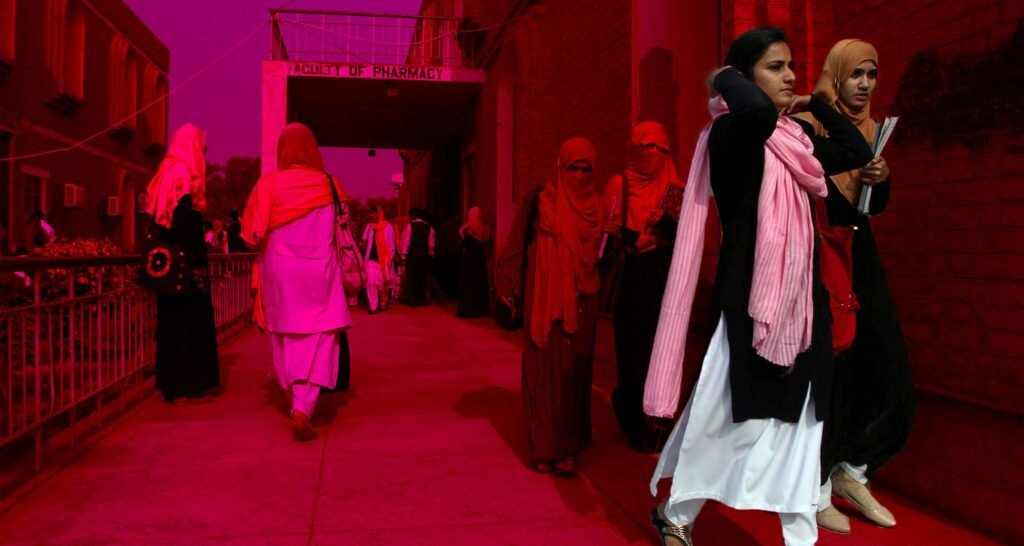
The affiliated college system does not record the students it exhausts. It does not count those who take a break and never return. Official data tracks enrollment and completion. It does not track the years lost to administrative backlog, the money spent on supplementary exam fees, or the moment a student decides the loss belongs entirely to them.
I have navigated the system from the inside for six years. The following account belongs here not as a complaint but as evidence. What happened is not unusual. That is the point.
It is not that my time was completely wasted. I achieved things in life through other paths as well. But academics have always been my kirmizi cizgi, my red line, the one thing I have worked tirelessly for over the last six years. Yet despite all the effort, it has never given me peace or stability in return. Sometimes, like thousands of other students, I also think about taking a break or dropping out completely. But I cannot do that, because no one else would lose anything from it. The loss would be entirely mine. The author
This is what higher education in Pakistan produces for students inside the affiliated system. Not a degree. Not a job. A calculation about whether continuing is worth the cost, and the recognition that stopping makes the loss personal even when the cause is structural.
The system does not lose when a student disappears. The student loses everything.
The Reports Exist. The System Has Read Them. Nothing Changed.
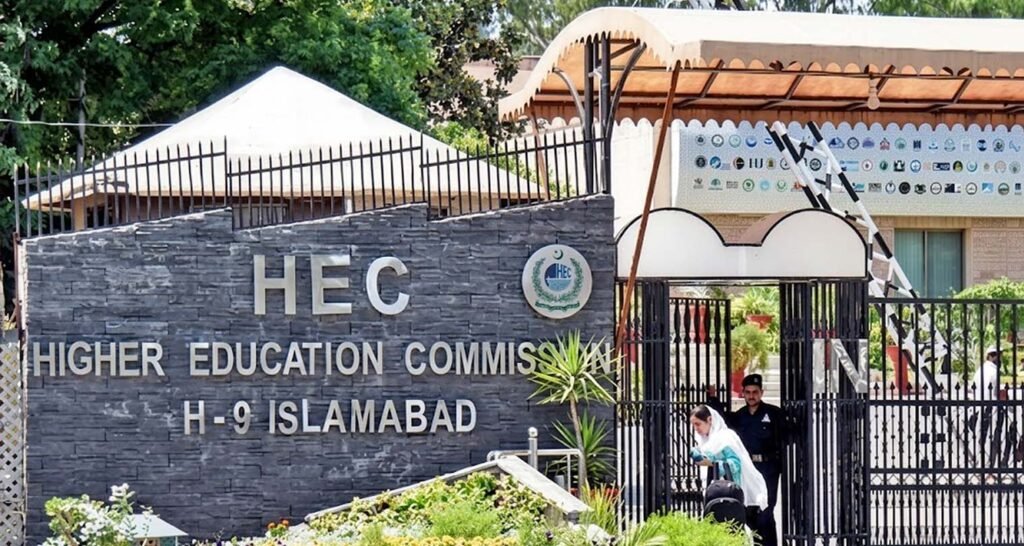
Pakistan has not failed to diagnose this crisis. It has diagnosed it repeatedly. The PIDE research papers exist. The Labour Force Survey exists. The HEC annual reports exist. Every dataset from 2020 through 2026 points to structural failure. The reports sit untouched in policy libraries. This massive oversupply of degree holders continues. The employment gap does not close.
The 2023 policy aims for competency-based education. It promises labor-market alignment and interdisciplinary learning. These are the right goals. Yet, they do not fix structural delays. A student enrolled in 2022 still sits exams in 2026. Policy documents and lived experience operate in separate universes.
Dr. Nadeem ul Haque, has argued that Pakistan’s post-2002 HEC expansion rewarded quantity over quality. Writing from that institutional position, he documents a system that produced degrees without building the markets to receive them. He attributes this to a structural framework that prioritises certification over capability. The HEC Annual Report FY 2022-23 records 154 development projects and Rs 43.373 billion disbursed to institutions. It does not record how many of those graduates found work.
A student spending six years on a two-year degree reflects institutional failure. A country producing that student by the thousands confirms it. The data makes this case. The students living it make it louder.
Every year Pakistan waits, another cohort runs the same calculation. The loss belongs to them. The decision belongs to the system. Only one of those two things has changed in the last decade, and it is not the system.




This article presents a very authentic and well-researched perspective on Pakistan’s higher education. The writer has given a clear and interesting description of the challenges, options, and realities of education. I truly appreciate a detailed and diverse discussion of such a serious issue. Both learners and educators will discover this to be an engaging and instructive read.