
MARWA TAHIR / Pakistan
Society praises women who sacrifice and punishes women who thrive. The uncomfortable question is not only who built this standard, but who has been teaching it to daughters ever since.
There is a ‘Good woman’, society has always known how to recognize. She is soft-spoken. She is selfless. She forgives quickly and asks for little. She puts her children before her career. She put her husband’s needs before her own. Her family’s comfort before her own peace. She is the ideal. She is also a construction worker. Not a discovery of something natural in a female character. A prescription written over centuries.
Handed down through every generation that followed, often by women themselves.
Simone de Beauvoir named what this construction produces in The Second Sex (1949). The woman is cast as the Other. The negative against which the male subject defines himself. The myths built around her are not descriptions of what women are. They are instructions for what women must become to be acceptable. She was not born. She is assigned.
This piece does not argue that nurturing is wrong or that sacrifice has no value. It argues that when only women are expected to sacrifice, when care is assigned by gender rather than chosen freely, the myth has done its work. The most effective delivery mechanism is not a law or a ruling. It is a grandmother’s voice at a family dinner. Shaping the next daughter into the correct shape.
What the Good Woman Myth Actually Is

The Good Woman myth is a set of prescriptive stereotypes that define socially approved femininity as selfless, nurturing, pure, agreeable, and emotionally available, while simultaneously dismissing those same qualities as evidence that women are too irrational or too soft for positions of real authority.
Betty Friedan named a version of this myth in 1963 in The Feminine Mystique. She called it the problem that has no name. The post-war American ideal told women their ultimate fulfillment arrived through domesticity: through husband, children, kitchen. Women who felt the edges of this pressing against them were told the feeling was personal failing. They had everything a woman could want. The dissatisfaction was their defect. Not the myth’s.
Sandra Lee Bartky traced the mechanism by which this myth becomes internal in her 1988 essay “Foucault, Femininity, and the Modernization of Patriarchal Power.” She applied Foucault’s concept of the panopticon to the female body. This ideal woman does not need to be watched by a guard. She watches herself. She monitors her weight, her tone, her expression, her ambition. She regulates herself into docility. The standard has become her own desire. She cannot see the difference. The myth succeeds when the woman imposes it on herself.
Raewyn Connell’s concept of emphasized femininity, in Masculinities (1995), gives this a structural name. Emphasized femininity is femininity defined as complementary and subordinate to hegemonic masculinity. Their softness is designed to make male dominance look natural. The Good Woman makes the system look like harmony rather than hierarchy.
Generational Trauma: Survived, Never Healed.
Is the Pedestal a Compliment or a Cage?
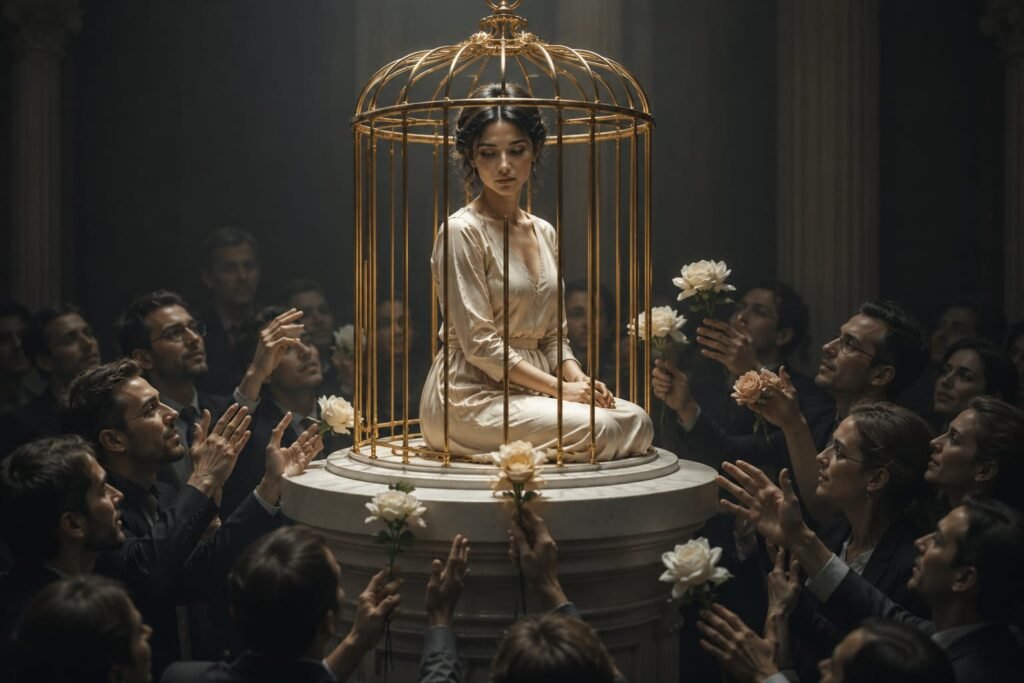
Alice Eagly and Antonio Mladinic published research in the European Review of Social Psychology in 1994. They called the finding the Women Are Wonderful effect. Their findings showed women are stereotyped as more communal. Kinder, warmer, more helpful. The effect sounds like praise. It is not. The communal stereotype confines women to subordinate, caretaking roles. The positive quality becomes the justification for exclusion.
Peter Glick and Susan Fiske formalized this in 1996 with the Ambivalent Sexism Inventory, in the Journal of Personality and Social Psychology. Their framework distinguishes two forms of sexism. Both operate together. Hostile sexism is the overt punishment of women who challenge male power. Benevolent sexism is the subjectively positive reverence for women in their proper roles as wives, mothers, and romantic objects. The pedestal version of this ideal is benevolent sexism in operation. It appears to honor women. It controls them. Glick and Fiske found these two forms positively correlated across nations. Where you find one, you find the other.
Research by Matthew Hammond and Nickola Overall, in Personality and Social Psychology Bulletin (2015), shows men who endorse benevolent sexism are more likely to discourage their partners’ career ambitions. They frame this as care and protection. The woman is looked after. She is also kept in place. The cage is lined with compliments.
Gender and Decision Making: Raised to Lead. Raised to Ask.
The Double Bind: She Must Be Both Good and Capable, and the World Will Not Allow It

The expected woman is communal. The competent woman is agentic. These two categories are treated as mutually exclusive. That is the trap.
Rudman and Glick documented this in the Journal of Personality and Social Psychology in 1999. Women who display ambition or assertiveness violate the communal prescription. They face what Rudman and Glick call the backlash effect. They are seen as less likable and less hirable. The cost of competence is being found difficult. The cost of pleasantness is being found unserious. The woman is penalized in either direction.
Joan Williams and Rachel Dempsey named four patterns of this bind in What Works for Women at Work (2014). Prove-It-Again: women must demonstrate competence repeatedly before receiving credit given to male colleagues automatically. The Tightrope: the requirement to be both competent and likable, a combination the myth makes structurally impossible. The Maternal Wall: the assumption that motherhood ends professional seriousness. The Tug of War: women turned against each other by a system with room for only a few.
Virginia Woolf saw this in 1931. In “Professions for Women” (1931), Woolf described the Angel in the House. The phantom of the self-sacrificing, utterly unselfish woman who haunted her as she wrote. Every time she reached for an honest critical opinion, the Angel intervened. Woolf wrote that she had to kill the Angel before she could do her work. The Angel did not live outside her. She lived inside, installed by years of the same myth this piece is examining.
Arlie Hochschild named a different dimension of the same demand in her 1983 book The Managed Heart. Emotional labor is the requirement to produce and manage feelings: warmth, calm, reassurance, care. The Good Woman is the quintessential emotional laborer. This labor is demanded not only in her home but in every workplace where she is present. It is largely invisible. It is largely unpaid. It is almost never demanded of men at the same rate.
Higher Education in Pakistan: Who Gets In, Who Drops Out
Who Is Actually Teaching the Good Woman Myth to the Next Generation?

This is the most uncomfortable part of the argument. This myth does not survive because men impose it against women’s will. It survives because every generation raised inside it raises the next generation inside it too.
Bartky describes this as the internalization of the surveillant gaze. A woman who has monitored herself for compliance does not always know she is doing it. It feels like values. It feels like love. When she tells her daughter to speak more softly, to not be so demanding, she is not consciously reproducing a patriarchal instruction. She is passing on what kept her safe, what earned her approval, what her mother told her and her mother’s mother before her.
This is the intergenerational transmission of this myth. It does not require force. It requires mothers. It requires aunts and grandmothers and teachers. It requires the look one woman gives another who asks too much. Wants too openly. Refuses to apologize for her ambitions. The myth travels through care, not cruelty. That is what makes it so difficult to see clearly.
Kimberlé Crenshaw’s intersectionality framework, from her 1989 paper “Demarginalizing the Intersection of Race and Sex,” adds a necessary complication. The Good Woman myth is not identical across all women. The pedestal of the virtuous woman has historically been extended to white, middle-class femininity and withheld from others. Black women, working-class women, and women in the Global South have never been offered the same pedestal. They face the expectations of communal sacrifice without the protections the benevolent sexist framework offers others. The myth operates differently across race and class. But its requirement of sacrifice does not disappear. It intensifies.
Transactional Marriage in Pakistan: The Daughters Who Pay
Morally Good, Intellectually Dismissed

The Good Woman myth holds two contradictory beliefs in the same hand. The first is that women are morally superior: kinder, more virtuous, more emotionally wise than men. The second is that women are less fit for rational authority, for political leadership, for complex ethical reasoning. Both beliefs are part of the same system. The pedestal is built on a dismissal. The praise is the cage. Research by Orly Bareket and Nurit Shnabel, published in Psychological Review in 2022, models this precisely. They found that stereotyping leads to perceiving women as more morally good but less morally competent. She is wonderful. She is also, the system quietly insists, not quite qualified to decide.
This is the deepest function of the Good Woman myth. It assigns women moral authority in the private sphere, in the home, in care work, in emotional labor, while simultaneously using that assignment to exclude them from moral and political authority in the public sphere. She is too good for politics. She is too pure for power. The compliment is the disqualification.
Betty Friedan named the same structure in 1963 when she wrote that the feminine mystique told women that their highest calling was the perfection of domestic sacrifice. Women who pursued anything beyond that calling were told they were failing their nature. The myth does not only praise the Good Woman. It makes any other kind of woman into evidence of something gone wrong.
Why Social Media Is Making You Feel Worse Without You Noticing
The Counterarguments That Deserve a Serious Answer

A rigorous treatment of this argument requires engaging the strongest counterpoints, not the weakest ones.
Simon Baron-Cohen argues in The Essential Difference (2003) that certain average psychological differences between men and women are innate rather than purely socially constructed. His work is heavily contested within the scientific community, and its findings have been disputed by subsequent research. But the question it raises is real: do some of the traits associated with the Good Woman myth reflect genuine average differences that any honest account must consider? The answer does not have to settle the debate. It does have to acknowledge that the debate exists.
Camille Paglia, in Sexual Personae (1990), offers a different challenge. She argues that recognizing inherent power dynamics and archetypes is not a delusion to be deconstructed but a confrontation with nature and art. Her Nietzschean view holds that the social constructionist model underestimates the power of feminine archetypes. This is not a defense of the Good Woman myth. It is a challenge to the assumption that dismantling this standard is straightforwardly liberating.
Christina Hoff Sommers argues in Who Stole Feminism (1994) that the framing of women as perpetual victims of patriarchal delusion removes their agency. This critique has real force. Compliance with this standard is sometimes a rational survival strategy, not false consciousness. Laurie Rudman and Peter Glick’s backlash research shows the penalties for non-compliance are real and material. A woman who rejects this standard does not simply feel liberated. She often faces real economic and social consequences. From the inside, compliance looks like reasonable risk management.
None of these counterpoints refute the central argument. They complicate it honestly. That is what strong journalism requires.
Feminism in Pakistan: The Bold Struggle Between Faith, Culture, and Equality
Who the Good Woman Is Actually Serving

Patriarchy does not survive because of guards and laws alone. It survives because both men and women are taught to see certain expectations as normal, as natural, as simply the way things are. This myth is the most effective tool in that education. It does not look like control. It looks like a compliment.
When a mother tells her daughter to be less demanding, she is not consciously implementing oppression. She passes on the survival knowledge that kept her acceptable. In a world that punished women who asked for too much. The problem is not the mother. The problem is the system that made that survival knowledge necessary. Then called it virtue.
Virginia Woolf wrote in 1931 that killing the Angel in the House was necessary before she could write an honest sentence. She did not mean killing care or warmth or generosity. She meant killing the voice that told her to reduce herself before thinking. That voice does not come from outside. It comes from inside. Installed by Good Women teaching other women how to be good.
The Good Woman myth does not ask women to be bad. It asks them to be small. The reason so many women comply is not weakness. It is a rational response to a system that penalized women who refused. Changing the response requires changing the system. Not blaming the women who learned to navigate it.
The first step is naming what this is. Not a celebration of female virtue. A set of instructions that benefits those who wrote them more than those who follow them. The Good Woman is real. She is working very hard, in every household where the invisible labor never gets counted, in every meeting where her competence is doubted before her warmth is praised. She deserves more than a pedestal. She deserves a system that does not require her to shrink in order to be loved.







The topiv pays attention to how cultural expectations can limit women’s freedom and individuality. It challenges norms and promotes the importance of equality of opportunities for all.